Review by Adeleke Babatunde
I have always loved the military, and what I love most is the discipline. The early mornings, the economy of speech, the idea that a person can be shaped into someone who does the hard thing on time and without complaint. In 2013 I was ready to go to flying school. I had read every book on the air force I could find and watched every film about it that I could get my hands on. My father was sceptical, and then the night of 3 October 2013 arrived. I still remember NTA breaking the news of the Associated Airlines crash in Lagos, the flight that was carrying the remains of the former Ondo State governor, Olusegun Agagu, home for burial. My father did his own searching online and found that the aircraft was more than ten years old. As I remember it, a military jet went down in training the very next day. That was the end of my pilot dream, though never of my fascination with the force.
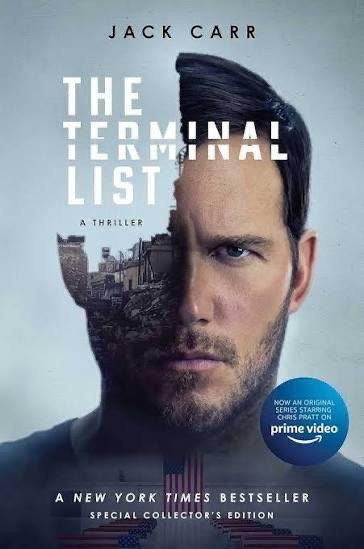
So when I recently started The Terminal List, I watched it the way an old enthusiast watches anything with uniforms in it. This is not a review. It is what the series left me thinking about once the gunfire stopped.
A Soldier Who Believed in the Mission
The series, adapted for Prime Video in 2022 from Jack Carr’s 2018 novel, follows Lieutenant Commander James Reece, a US Navy SEAL played by Chris Pratt (Carr, 2018; Amazon Studios, 2022). A covert mission in Syria goes disastrously wrong and most of his platoon is killed. Back home, Reece suspects that the official report is hiding the truth. The only other surviving teammate dies by apparent suicide, Reece struggles with memory gaps and a brain tumour linked to an experimental military drug, and then his wife and daughter are murdered in an attack that was meant for him. What follows is a methodical campaign of vengeance against the people on his list: private military contractors, corrupt officials and senior brass who profited from the ambush and then buried it.
It is exactly my kind of television. It is fast, physical and loud, and the dialogue is written in the register of operations: call signs, rules of engagement, the clipped logic of people who plan before they act. But beneath the combat sits a premise that is much older and much darker than any firefight. Reece is a man who has given everything to an institution and discovers that the institution has spent him like currency. The enemy he was trained to look for abroad is sitting in the rooms where the orders are signed.
That idea is not new. Smedley Butler, a US Marine Corps major general, argued as far back as 1935 that war was a racket run for the profit of a few and paid for with the lives of many (Butler, 1935). In 1961 President Eisenhower, himself a five-star general, used his farewell address to warn Americans against the unwarranted influence of what he named the military-industrial complex (Eisenhower, 1961). The soldier takes an oath to defend the constitution against all enemies, foreign and domestic (10 U.S. Code § 502). The series asks the uncomfortable follow-up question that the oath never answers: what happens when the domestic enemy wears a uniform with more stars on it than yours? The macho certainty that a soldier is saving his country from outsiders looks very different once you consider how often the decisions that send him to die were made for contracts, careers and cover stories.
The Banality of the Machine
Watching Reece work through his list, I kept returning to Hannah Arendt’s Eichmann in Jerusalem, her report on the 1961 trial of Adolf Eichmann, the administrator who organised the transport of Jews to the death camps (Arendt, 1963). Her subtitle gave the world a phrase it has misused ever since: the banality of evil. Banality does not mean that atrocity is trivial or ordinary. It describes how atrocity is carried out. Arendt was struck that Eichmann was neither a monster nor a fanatic in the courtroom. He was a careerist who spoke in clichés and had stopped asking what his work actually did to other human beings. The failure she identified was a failure of thought, of judgement and of the imagination needed to see another person’s suffering from where they stand.
This is the part of her argument that fits the series best. Evil on an industrial scale does not need an army of sadists. It needs ordinary people inside an administrative system who treat the forms, the chain of command and the next promotion as the whole of moral reality. Zygmunt Bauman pushed the point further, arguing that modern bureaucracy is efficient at precisely this separation, because it divides a project into small tasks so that nobody who performs one feels responsible for the outcome (Bauman, 1989). Stanley Milgram’s laboratory studies gave the idea an uncomfortable number: in his baseline experiment roughly two thirds of ordinary participants went on administering what they believed were dangerous electric shocks because an authority figure told them to continue (Milgram, 1974). The contractor who signs off the cover-up, the officer who forwards the sanitised report and the analyst who does not ask why the numbers changed are all small gears in the same machine, and the machine does not need any of them to hate anyone.
There is also a fair caution to make. Scholars have challenged Arendt’s portrait of Eichmann. Bettina Stangneth, working from Eichmann’s own pre-trial writings and interviews, argued that he was a committed and ideologically driven antisemite who performed bland bureaucratic innocence in court (Stangneth, 2014). The honest reading is that both things can be true of a system: it contains true believers at the top and a great many conforming functionaries beneath them. The Terminal List shows both. It gives us a handful of villains with names and faces, and behind them a crowd of people who simply did as they were told.
This is where the series becomes interesting as an argument rather than just entertainment. Reece is the rare soldier who refuses to conform. He questions the report, he follows the evidence and he will not let the official story stand. In Arendt’s terms he is a man who still thinks. And yet the genre hands him a convenient gift: a finite list. Kill the right names and the rot ends. Arendt’s lesson is more troubling, because a system that runs on conformity does not stop when its most visible figures fall. It replaces them from a line of equally obedient successors. Fiction can offer the satisfaction of a vengeance that clears the board, but the real defence against the banality of evil is slower and less cinematic. It is the clerk who reads what he is asked to sign, the officer who asks who benefits, and the citizen who keeps thinking when thinking is inconvenient.
I still admire the discipline of the force, and nothing in this series has changed that. But watching it as a grown man who once wanted the uniform, I find the message sharper than the action. Discipline without judgement is not a virtue. It is simply the most dependable raw material that any machine, good or evil, can ask for.