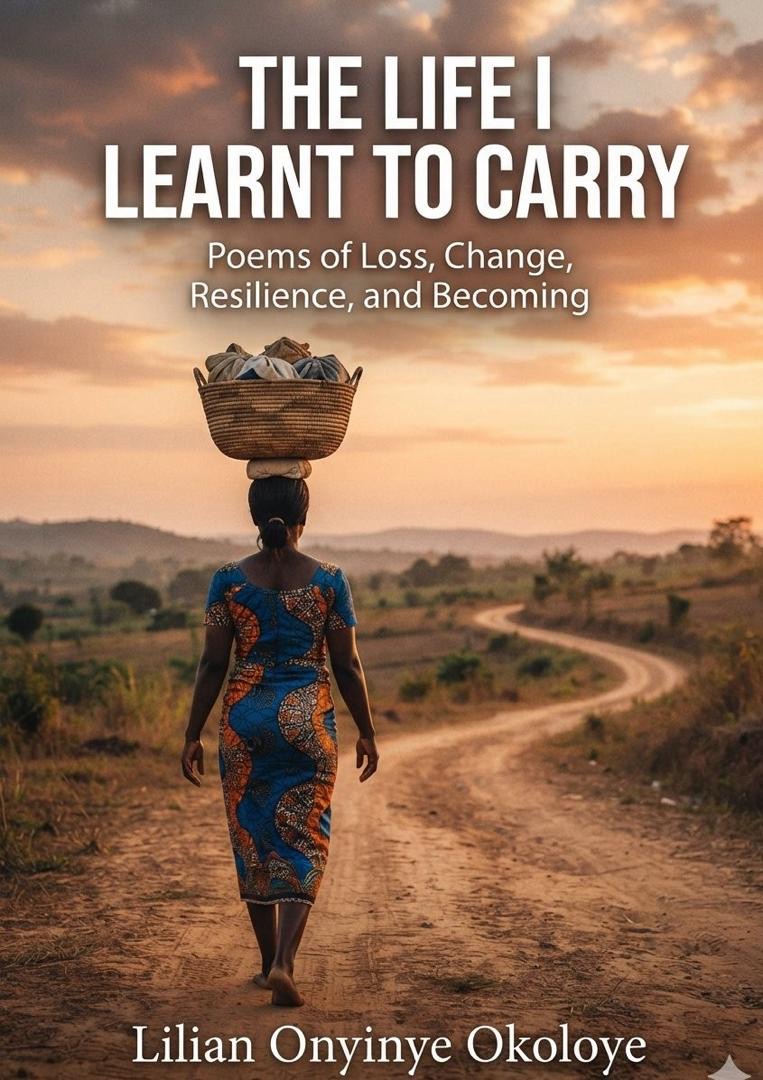
Lilian Onyinye Okoloye’s debut traces the slow education of loss, migration, and the quiet decision not to become what hurt you.
By Staff Revie
Review by Adeleke Babatunde
Lilian Onyinye Okoloye’s The Life I Learnt to Carry is a book about weight. Not the dramatic weight of a single catastrophe, but the accumulated load of ordinary days that refuse to stay ordinary: a mother’s death that arrives on an ordinary morning, a job market that keeps translating a life into smaller and smaller boxes, a workplace that teaches the difference between silence and disappearance. The poems are plainspoken, sometimes almost stubbornly so. They do not perform difficulty. They record it, then ask what a person is allowed to become on the other side.
Okoloye comes to the page with an unusual combination of training. She holds a BSc in Computer Science Education and an MSc in Digital Marketing Communication, and she works as a Healthcare Assistant. The poems carry that double knowledge: the analytical habit of someone used to systems, and the intimate proximity to human vulnerability that caregiving requires. The result is a collection that is less interested in literary display than in the ethics of surviving without hardening.
The book’s strongest sequence begins with the mother’s death. In “When You Left,” the speaker is not ready for the phone call. “There are some sentences / that split a life in two / before you hear them.” The line is simple, and it is exact. Grief, the poem insists, is not one terrible moment. It is a thousand small moments afterward: cooking and suddenly remembering how she used to make it, hearing a voice that sounds almost like hers and turning before the mind catches up, reaching for the phone because something happened and she is still the first person the heart wants to tell.
What makes the poem work is its refusal of tidy consolation. People say she is in a better place. Maybe. “But there are days / when I do not need an explanation. / I just need my mother.” The distinction is the poem’s moral centre. Explanation is what the living offer the living. Need is what remains when explanation has done all it can. Later the speaker learns that remembering does not always have to hurt, that she can smile at a memory without betraying the sadness, that she can carry her mother without being trapped in the day she lost her. The closing claim is quiet and absolute: “You are my mother. / And even death / cannot change that.” It is not a triumph. It is a refusal to let death rewrite the relationship.
If the grief poems measure private loss, “The Job Hunt” measures the public translation of a self. The speaker arrives with more than a suitcase: certificates, experience, a CV “carefully folded / into the shape of possibility.” She learns the language of applications. Please find attached. I am writing to express my interest. She learns how to turn a life into bullet points, how to make years of experience fit inside a little box, how to explain her worth without sounding like she is begging to be believed. Then comes the waiting: the kind that makes you check your email before your eyes are fully open, the kind that teaches how many ways a person can be rejected without the word no ever appearing.
There is a particular humiliation in this process that Okoloye captures without self-pity. Qualifications seem to have grown smaller since crossing the border. The person she had been before is no longer fully visible on this side of the world. She changes the sentence, the format, the photograph, the wording. She reads the job description five times, hunting for the secret combination that might unlock a door. In interviews she carries confidence in one hand and uncertainty in the other. She smiles. She answers carefully. She tries not to let them hear how badly she needs the opportunity.
The poem’s turn is its most interesting move. Somewhere between the applications and the waiting, something else is happening. She is learning how to introduce herself again, how to speak about her abilities without apology. “Starting over / does not mean starting from nothing.” She is not empty-handed. She is simply in a place where her experience has to be translated. The distinction matters. It refuses the narrative that migration erases the self. It also refuses the narrative that persistence is automatically rewarded. She keeps knocking, not because rejection has promised her success, but because she has not yet run out of reasons to believe in what she carries.
“Who I Chose To Be” is the collection’s ethical core. In a workplace where the way she is spoken to stays with her long after the conversation ends, where instructions are unclear and expectations shift, she learns a form of restraint that is not disappearance. “I will not become you / because you hurt me.” That becomes her quiet boundary. She can disagree without being disrespectful. She can speak up without becoming aggressive. She can say no without becoming difficult. She can ask for clarity without apologising for needing it. Eventually she stops measuring herself by the behaviour of other people. “That was freedom.”
The poem’s definition of resilience is one of the more carefully earned statements in the book. Resilience is not becoming hard. It is not pretending nothing hurts. It is not smiling through everything and calling it strength. It is feeling the weight and still choosing what to carry out of the room. The claim could easily tip into self-help. It does not, because it is grounded in the specific cost of remaining dependable when frustration gives every excuse not to be. Okoloye is interested in the ethics of not transmitting harm. That interest gives the poem its spine.
Elsewhere the collection turns to migration’s slower weather: culture shock, learning the roads, money that has other plans, the weight of ordinary days in a country that does not yet feel like home. These poems are competent and occasionally sharp, but they rarely reach the pressure of the grief sequence or the job-hunt sequence. The language stays close to statement. Images are fewer. The poems know what they want to say, and they say it. That clarity is a strength when the material is specific. It becomes a limitation when the material thins into general reflection on becoming and resilience.
Formally the book is modest. Free verse, short lines, conversational breaks. There is little interest in compression, sonic patterning, or structural risk. When the experience is particular, the plainness works. When the thought goes general, the language has nowhere to hide. Like several recent self-published debuts working in a similar register of accessible testimony, Okoloye is stronger on witness than on formal invention. The poems do not try to outsmart the reader. They try to be recognised by the reader who has also checked an email before the eyes were fully open, or reached for a phone that will never be answered by the person they need.
What the collection finally offers is an education in carrying. The life Okoloye has learnt to carry includes a mother’s absence, a border that translates a self into smaller credentials, a workplace that tests the difference between restraint and erasure, and the ongoing work of remaining soft enough to feel without becoming so soft that the world can rewrite her. The book does not claim that this carrying is heroic. It claims that it is possible. That claim is quieter than triumph, and more useful.
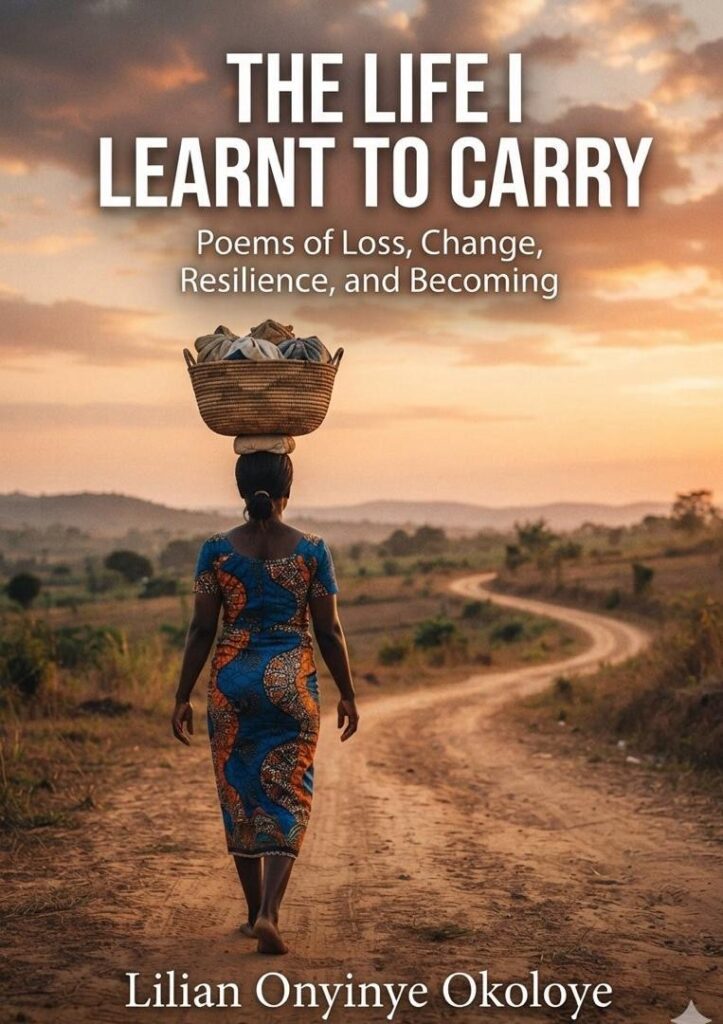
The Life I Learnt to Carry is an honest debut more than a fully realised one. It records a life examined while still in motion: the phone call that split the day, the CV folded into the shape of possibility, the quiet decision not to become the person who hurt you. When Okoloye trusts the specific bruise and the specific waiting, the poems hold. When she reaches for the lesson, they sound like the kind of poetry that comforts more readily than it unsettles. Both impulses are present. The more interesting one is the one that has not yet decided how the sentence should end. The woman walking the road with the basket on her head, on the cover of the book, is still walking. The poems know that. At their best, they walk with her.
THE LIFE I LEARNT TO CARRY
Poems by Lilian Onyinye Okoloye